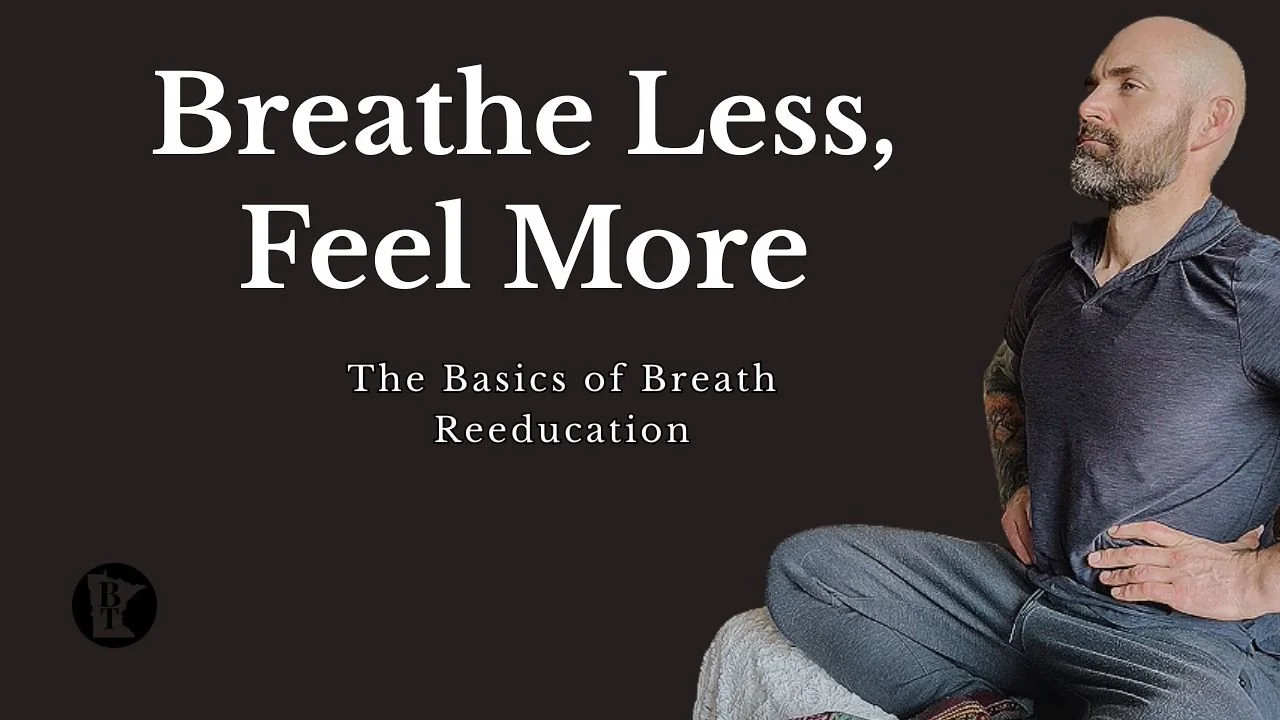
Breathe Less, Feel More
Instead of trying to control your breath…
Let your breath guide your body.
Let the ribs expand.
Let the body respond.
This creates change at a subtle level—what we might call the soma.
And subtle changes, practiced consistently, create meaningful results.
At first glance breathing seems so simple.
You Inhale.
You Exhale.
You Repeat.
But there is far more going and every breath we take can influencing our health either negatively or positively.
Breathing is subtle and very hard to really notice, but the way you breathe has a direct influence on how you feel, how you move, and how your body & mind function. Even a subtle change can create a massive shift.
The challenging part for many people is putting away any idea that we know how to breathe, you must unlearn what you know and approach with a beginners mind. Curiosity, awareness, perception, these are necessary skills that are further cultivated by practicing breathing,
Breath Is More Than Air
Breathing is not just about supplying the body with oxygen.
It’s an entire system that influences:
Your physical body (structure and movement)
Your Energy (life force ~prana)
Your chemistry (oxygen and carbon dioxide balance balance Ph)
Your nervous system (stress and regulation)
Your Mind (focus and clarity)
Every breath reflects your current state.
And over time, the way you breathe can either support your system—or slowly work against it.
The Problem: Too Much Breathing
Most people don’t realize they are over-breathing. This is so hard to witness and change, but it starts with that, witnessing the pattern and knowing that it can be improved… indefinitely.
It is so easy to over breathe, it happens all day as many of our 20-30 thousand breaths re unconscious and part of an unconditioned habit. In fact, over breathing can be as simple as a yawn or any mouth breath.
It doesn’t necessarily mean faster or heavy breathing (which is absolutely overbreathing), it just means that we are taking more in than our metabolic demands, essentially— more volume than needed.
This can lead to:
Increased tension & pain
Reduced efficiency
Nervous system imbalance
Increased inflammation
More air is not always better.
In many cases, it’s the opposite.
The Goal: Less, But Better
Breath reeducation isn’t about forcing technique. I must strain this: You cannot force a change! Consistency, patience, persistence and positivity are the foundation which rests upon the bedrock of curiosity and awareness.
It’s about slowly refining the system.
Two key things begin to change (that are not nose breathing and diaphragmatic breathing):
Your breathing becomes slower: the ideal rate is 6 breaths per minute
Your breathing becomes quieter: ideally no sound or very minimal
Less effort.
Less excess.
More efficiency.
A Simple Way to Begin
One way to explore this is by slowing your breath down.
Try:
Inhale for about 5–6 seconds
Exhale for about 5–6 seconds
Keep it soft.
Keep it quiet.
Let the breath feel smooth, like a wave, gently transitioning between inhale and exhale and exhale into inhale.
Nothing forced, just rolling like a wave, smooth in and out, you’re letting go, and surrendering any bracing.
Bringing Awareness to the Breath
You can also introduce a light ujjayi breath—a gentle narrowing in the throat. It creates a light sound within and is usually practiced during the exhale, but can be done on the inhale as well.
This can:
Slow the breath naturally
Reduce excess air
Improve awareness
Help the diaphragm engage more effectively
Used lightly, it becomes a tool for sensing—not controlling.
Important tip with this practice: make your ujjayi breath subtle and quiet. No one around you should hear you, the sound is internal. It is also called “ocean’s breath” since the sound is like the smooth waves of the ocean on the beach. Imagine that while practicing your breathing and you will feel everything slowing down~ body, breath and mind.
Let the Body Follow
Instead of trying to control your breath, which, again, is very hard to do when your awareness is on your breathing, surrender to the breath…
Let your breath guide your body.
Let the ribs expand.
Let the body respond.
Allow the breath.
This creates change at a subtle level—what we call in yoga the pranamaya kosha.
And subtle changes, practiced consistently, create meaningful + lasting results.
Final Thought
Better breathing isn’t about doing more.
It’s about doing less—more intentionally.
Breathe less.
Feel more.
And always…
Stay consistent, patient, persistent and positive.
The Twist and the Cringe
A violent motorcycle accident left an imprint in my nervous system that shaped my posture, breath, and pain for decades. It wasn’t until somatic awareness and yoga therapy that I finally uncovered the pattern and began to unwind it.
How a Split-Second Trauma Shaped My Body for Twenty Years
My body reacted before I even knew what was happening.
One instant I was racing down the road on my Triumph Daytona — the next I was tumbling across the asphalt. My head tucked, my shoulders shrugged, and my entire body curled sharply to the left. I didn’t choose any of this. My nervous system did.
I remember the world spinning: sky, fields, asphalt, gravel — over and over.
I felt myself rolling like a stone skipping across water. I wasn’t resisting; I felt nothing, but saw everything. I was witnessing it happen as if it were a dream playing in the background.
My only conscious thought was, “Just stop rolling. just stop rolling…”
When I finally came to a stop, I stood up in shock. My shoes and socks were gone. My shirt shredded. My pants torn. And my motorcycle — the one I had so many close calls on — lay twisted on the ground in front of me. I had rolled directly behind it the whole way, watching it flip through the air as I tumbled after it.
I couldn’t believe where I stopped rolling — and that I did — for that matter. It was endless, I rolled so far, how I lived, I have no idea.
The Place I Crashed Was the Place I Once Found Peace
As I stood there shaking, adrenaline flooding my system, I looked around and realized exactly where I was.
The crash had happened right at the entrance of the Isaac Walton Wetland and Conservation Area — the place where I walk my dog, Murphy, almost every single day. I was here all the time, I loved this space, and would get lost there for hours. As I stood in the parking lot I looked back, the curve where I whipped out, was a long way away. How far did roll?
I knew that area so well.
I knew the fields, the river, the forests.
I had walked that path countless times.
Every time I drive there I come from the east, always entering the lot from the opposite direction — never from the side I rode in from that day. The curve was sharper than I anticipated, I hit gravel, and my bike disappeared from underneath me.
I was surprisingly unbroken, barefoot and trembling, I stood in the parking lot where my daily walks used to begin… except this time, my motorcycle was lying wrecked beside me, and my body was buzzing with shock, and ripped with road rash.
A place that had once been part of my routine, a place of familiar comfort, suddenly became the scene of a violent trauma.
And after that day —
after the rolling, the tumbling, the impact, and the month in the hospital —
I never returned.
It wasn’t a conscious choice.
My nervous system made that choice for me — drawing a boundary around the place where danger became real. Even years later, I stayed away without fully understanding why.
It would take two decades before the deeper significance of this accident, finally revealed itself.
The Imprint That Never Left
It wasn’t until twenty years later that I began to feel the echo of this trauma.
One day, while practicing Mountain Pose, I felt a subtle internal pull. I let it happen — curious, patient, open — and my body moved on its own:
My chin tucked left.
My shoulders spiraled left.
My abdomen cinched and braced left.
My entire left side curled inward.
And instantly, the memory of the motorcycle accident rushed back.
I had completely forgotten how violent the crash was. I always focused on cancer as the major trauma of my life. I never considered that this accident had shaped my posture, breath, and health just as much — maybe even more.
But in that moment, it was undeniable.
My body had been remembering all along.
Trauma Changes Posture
The protective shape I curled into during the crash became the pattern I lived in for decades. It became the hidden blueprint for how I stood, moved, breathed, and coped.
That twist became:
chronic low back pain
shoulder and neck tension
emotional heaviness
fatigue and depression
digestive issues
breath restriction
a constant sense of imbalance
Working in a kitchen amplified it.
Cancer amplified it.
My lifestyle amplified it.
I believed that training hard, eating paleo, and pushing myself mentally would heal me.
It didn’t.
It made the trauma pattern stronger.
I didn’t understand that trauma lives not in memory but in shape.
I didn’t understand that the nervous system stores protection in posture, and breathing.
I didn’t understand that the body keeps reenacting the moment it braced — until it feels safe enough to unwind.
The Nervous System Never Forgets
Even when the mind forgets, the body doesn’t.
When trauma goes unresolved, the nervous system keeps replaying the event — not through conscious memory, but through:
tension
posture
reflexes
breath
emotion
movement patterns
Mine replayed as a leftward spiral.
A kink.
A guard.
A cringe.
A shape learned in a split second and practiced unconsciously for twenty years.
Somatic Awareness: A Way Back
When I finally let my body show me its truth, something shifted.
Somatic practice taught me to:
feel the twist instead of collapsing into it
follow the pull without fear
explore the protective shape gently
unwind the trauma pattern slowly
retrain my breath and posture
rebuild a sense of internal safety
It’s not easy to sense misalignment when it’s all you’ve ever known. Even after a tremendous amount of practice. It can veil itself from our focused awareness with ease, and requires patience, persistence and positivity to shine the light into our darkest areas.
And, as awareness grows, the body reveals its story.
And with that story comes the possibility of change.
We can reprocess old experiences.
We can rebuild safety.
We can retrain the nervous system to let go.
A Shape of Protection, Not Failure
That twist — that cringe — was not weakness.
It was survival.
It saved my life. And is deeply ingrained in my being.
But survival mode is not meant to be permanent.
Yoga therapy, somatic movement, and breathwork helped me release the imprint, retrain my system, and come back toward center.
I’m still working on it.
Twenty years of a trauma pattern doesn’t disappear overnight.
But with consistent, dedicated work I continue to learn a new way, a way that not only feels great, but is reshaping the entire fabric of my well being. I know I will only continue to improve up until the day I die.
Healing isn’t magic. Your body IS the magic.
And every step — every breath — every moment of awareness can reshape your existence.