Breathe Less This Spring
The Nose Is Your First Line of Defense
Your nose is not just for breathing—it’s part of your immune system.
It filters the air.
It regulates airflow.
It protects your lungs from irritants.
When you breathe through your mouth, you bypass that protection.
More air enters.
More pollen enters.
More stress is placed on the system.
Nasal breathing slows things down and reduces the overall load on your body.
Spring, is amazing, maybe my favorite time of year, it brings a lot of good with it.
More light.
More color.
More time outside.
But it also brings something many people struggle with:
Allergies.
Congestion, irritation, and inflammation can make this season feel like something to get through rather than enjoy.
But there’s a simple place to start that often gets overlooked:
Your breath.
The Nose Is Your First Line of Defense
Your nose is not just for breathing—it’s part of your immune system, in fact, it is where the immune system starts.
It filters, conditions, cleanses, and prepares the air.
It releases Nitric Oxide to combat bacteria, viruses, mold, allergens.
It protects your lungs from irritants.
When you breathe through your mouth, you bypass that protection.
More air enters.
More pollen & pollutants enter.
More stress is placed on the system.
Nasal breathing slows things down and reduces the overall load on your body.
Less Breath, Better Function
One of the most helpful shifts you can make is this:
Breathe less.
Not by holding your breath aggressively…
but by reducing the volume of air you move.
When you breathe less:
You bring in fewer irritants
You improve carbon dioxide balance
You support better oxygen delivery
You reduce unnecessary stress on the system
It’s a subtle change—but a powerful one.
A Simple Practice: Short Breath holds.
Try this:
Sit comfortably and begin to gently sway or rock side to side.
Keep your breathing soft and quiet.
Every few breaths:
Exhale naturally
Pause briefly at the end of the exhale
Let the inhale return on its own
Stay relaxed.
Never force the pause.
Practice for a few minutes at a time.
This can help:
Open the sinuses
Reduce congestion
Improve tolerance to carbon dioxide
Bring the nervous system into a more regulated state
Supporting the System
You can also support your breathing and your body with a few simple habits:
Prioritize nasal breathing throughout the day
Wear a mask outdoors if pollen is high
Use a neti pot to clear the nasal passages
Try local raw honey as part of your routine
These aren’t complicated solutions—but they are consistent ones.
The Bigger Picture
Breathing is not just about getting air in and out.
It’s about how your body interacts with its environment.
When your breathing becomes more efficient, more subtle, and more intentional…
your system becomes more resilient.
Final Thought
The goal is not to breathe more.
It’s to breathe better.
And often, that starts with doing less.
Less air.
Less effort.
More awareness.
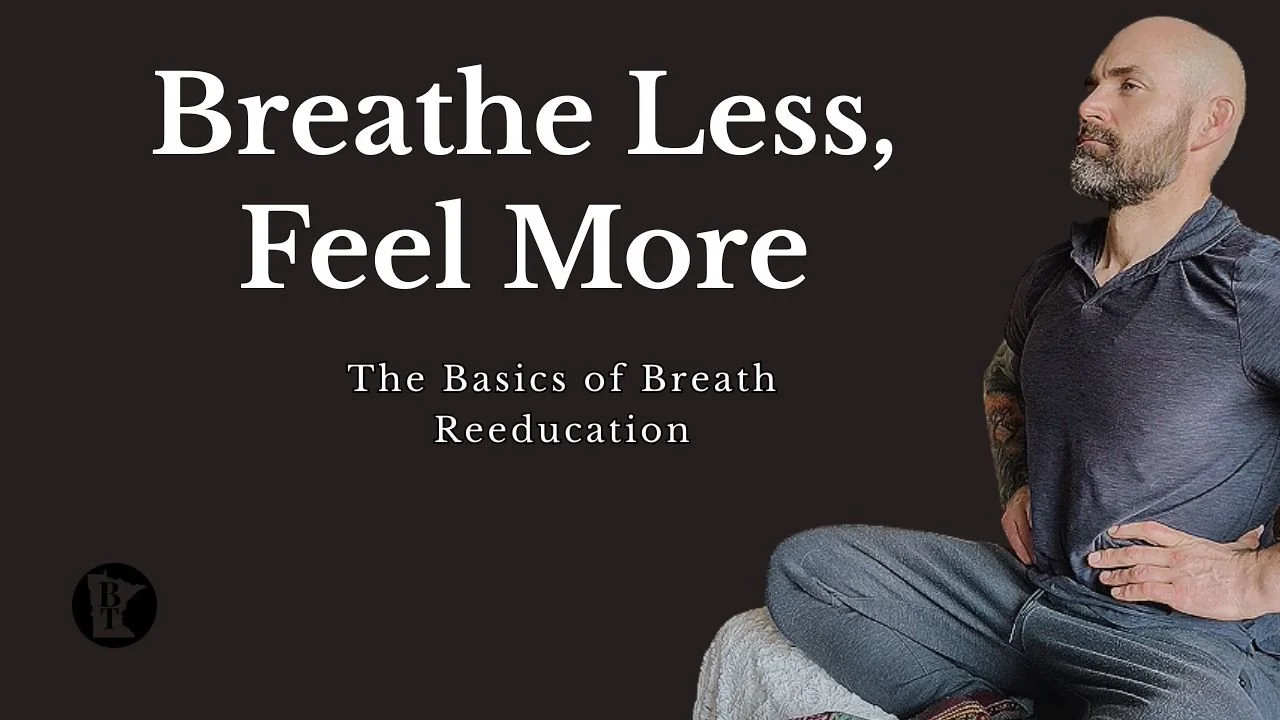
Breathe Less, Feel More
Instead of trying to control your breath…
Let your breath guide your body.
Let the ribs expand.
Let the body respond.
This creates change at a subtle level—what we might call the soma.
And subtle changes, practiced consistently, create meaningful results.
At first glance breathing seems so simple.
You Inhale.
You Exhale.
You Repeat.
But there is far more going and every breath we take can influencing our health either negatively or positively.
Breathing is subtle and very hard to really notice, but the way you breathe has a direct influence on how you feel, how you move, and how your body & mind function. Even a subtle change can create a massive shift.
The challenging part for many people is putting away any idea that we know how to breathe, you must unlearn what you know and approach with a beginners mind. Curiosity, awareness, perception, these are necessary skills that are further cultivated by practicing breathing,
Breath Is More Than Air
Breathing is not just about supplying the body with oxygen.
It’s an entire system that influences:
Your physical body (structure and movement)
Your Energy (life force ~prana)
Your chemistry (oxygen and carbon dioxide balance balance Ph)
Your nervous system (stress and regulation)
Your Mind (focus and clarity)
Every breath reflects your current state.
And over time, the way you breathe can either support your system—or slowly work against it.
The Problem: Too Much Breathing
Most people don’t realize they are over-breathing. This is so hard to witness and change, but it starts with that, witnessing the pattern and knowing that it can be improved… indefinitely.
It is so easy to over breathe, it happens all day as many of our 20-30 thousand breaths re unconscious and part of an unconditioned habit. In fact, over breathing can be as simple as a yawn or any mouth breath.
It doesn’t necessarily mean faster or heavy breathing (which is absolutely overbreathing), it just means that we are taking more in than our metabolic demands, essentially— more volume than needed.
This can lead to:
Increased tension & pain
Reduced efficiency
Nervous system imbalance
Increased inflammation
More air is not always better.
In many cases, it’s the opposite.
The Goal: Less, But Better
Breath reeducation isn’t about forcing technique. I must strain this: You cannot force a change! Consistency, patience, persistence and positivity are the foundation which rests upon the bedrock of curiosity and awareness.
It’s about slowly refining the system.
Two key things begin to change (that are not nose breathing and diaphragmatic breathing):
Your breathing becomes slower: the ideal rate is 6 breaths per minute
Your breathing becomes quieter: ideally no sound or very minimal
Less effort.
Less excess.
More efficiency.
A Simple Way to Begin
One way to explore this is by slowing your breath down.
Try:
Inhale for about 5–6 seconds
Exhale for about 5–6 seconds
Keep it soft.
Keep it quiet.
Let the breath feel smooth, like a wave, gently transitioning between inhale and exhale and exhale into inhale.
Nothing forced, just rolling like a wave, smooth in and out, you’re letting go, and surrendering any bracing.
Bringing Awareness to the Breath
You can also introduce a light ujjayi breath—a gentle narrowing in the throat. It creates a light sound within and is usually practiced during the exhale, but can be done on the inhale as well.
This can:
Slow the breath naturally
Reduce excess air
Improve awareness
Help the diaphragm engage more effectively
Used lightly, it becomes a tool for sensing—not controlling.
Important tip with this practice: make your ujjayi breath subtle and quiet. No one around you should hear you, the sound is internal. It is also called “ocean’s breath” since the sound is like the smooth waves of the ocean on the beach. Imagine that while practicing your breathing and you will feel everything slowing down~ body, breath and mind.
Let the Body Follow
Instead of trying to control your breath, which, again, is very hard to do when your awareness is on your breathing, surrender to the breath…
Let your breath guide your body.
Let the ribs expand.
Let the body respond.
Allow the breath.
This creates change at a subtle level—what we call in yoga the pranamaya kosha.
And subtle changes, practiced consistently, create meaningful + lasting results.
Final Thought
Better breathing isn’t about doing more.
It’s about doing less—more intentionally.
Breathe less.
Feel more.
And always…
Stay consistent, patient, persistent and positive.
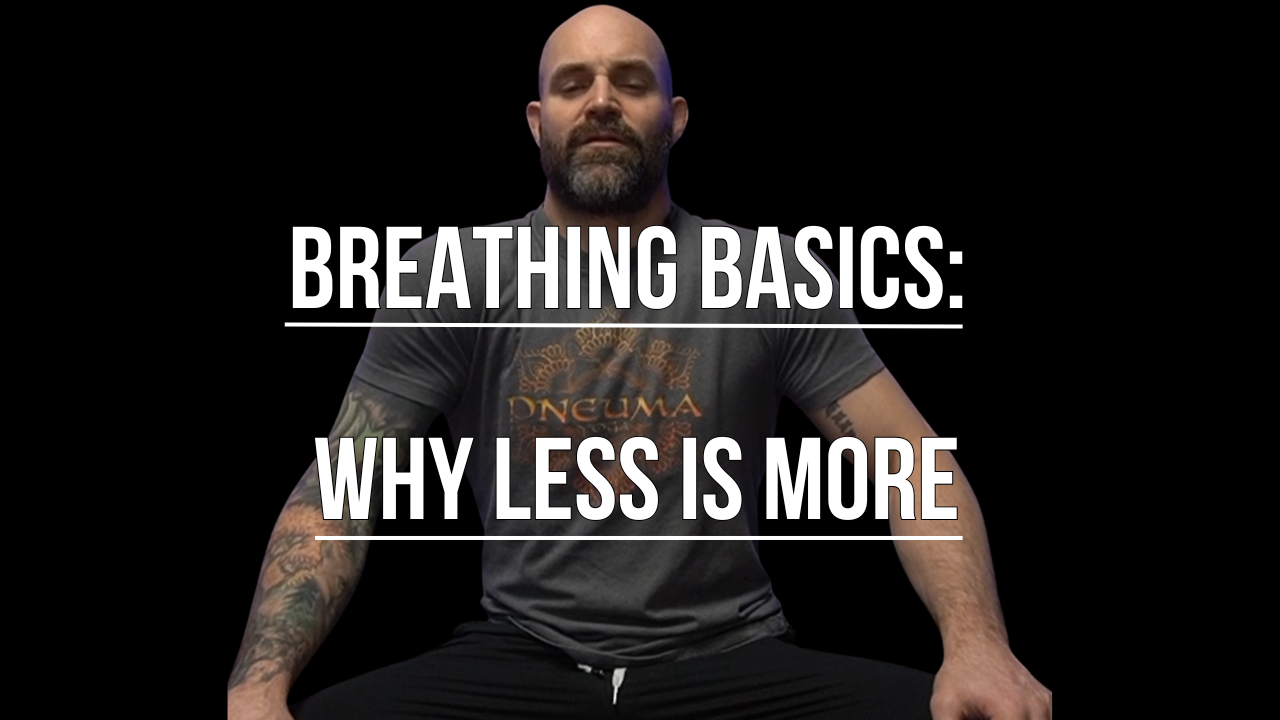
Breathing Basics: Why Less Is More
Breath is not just something you do—it’s something that moves you.
Every movement in your body is influenced by your breathing. Your ribs expand, your spine responds, and your tissues shift with every inhale and exhale.
Breath is the body’s internal rhythm.
When breathing is restricted, movement becomes restricted.
When breathing is smooth, movement becomes fluid.
If you want to move better, it starts with how you breathe.
Breath Is Movement
Breath is not just something you do—it’s something that moves you.
Every movement in your body is influenced by your breathing. Your ribs expand, your spine responds, and your tissues shift with every inhale and exhale.
Breath is the body’s internal rhythm.
When breathing is restricted, movement becomes restricted.
When breathing is smooth, movement becomes fluid.
If you want to move better, it starts with how you breathe.
Breathing Is More Complex Than It Seems
At first glance, breathing looks simple: inhale, exhale, repeat.
But beneath that simplicity is a system influenced by:
Biochemistry — how your body uses oxygen and carbon dioxide
Biomechanics — how your ribs, diaphragm, and posture move
Psychosocial factors — stress, habits, and environment
Every breath reflects your internal state.
And over time, inefficient breathing patterns can reinforce tension, fatigue, and dysregulation in the body.
The Problem: Too Much Breath
One of the most common issues is not a lack of breath…
…but too much of it.
Over-breathing—moving more air than your body needs—can lead to:
Increased tension
Reduced efficiency
Nervous system imbalance
The solution isn’t to breathe bigger.
It’s to breathe more appropriately.
The Goal: Reduce Rate and Volume
Breath reeducation is not about forcing technique.
It’s about refining the system.
Two key variables:
Respiration rate (how fast you breathe)
Respiratory volume (how much air you move)
When both begin to decrease—naturally and without strain—the body becomes more efficient.
A Simple Exploration
Try this:
Count how many breaths you take in one minute
Then slow it down:
Inhale for ~5.5 seconds
Exhale for ~5.5 seconds
Don’t force the breath.
Let it become quieter.
Let it become smoother.
Let the Breath Move the Body
Instead of trying to control your breath…
Allow your breath to guide movement from within.
Let the ribs expand.
Let the body respond.
This creates change at a subtle level of the body—the soma.
And subtle changes, practiced consistently, create powerful results.
Final Thought
Better breathing isn’t about doing more.
It’s about doing less—more intentionally.
Less breath.
Less effort.
More awareness.
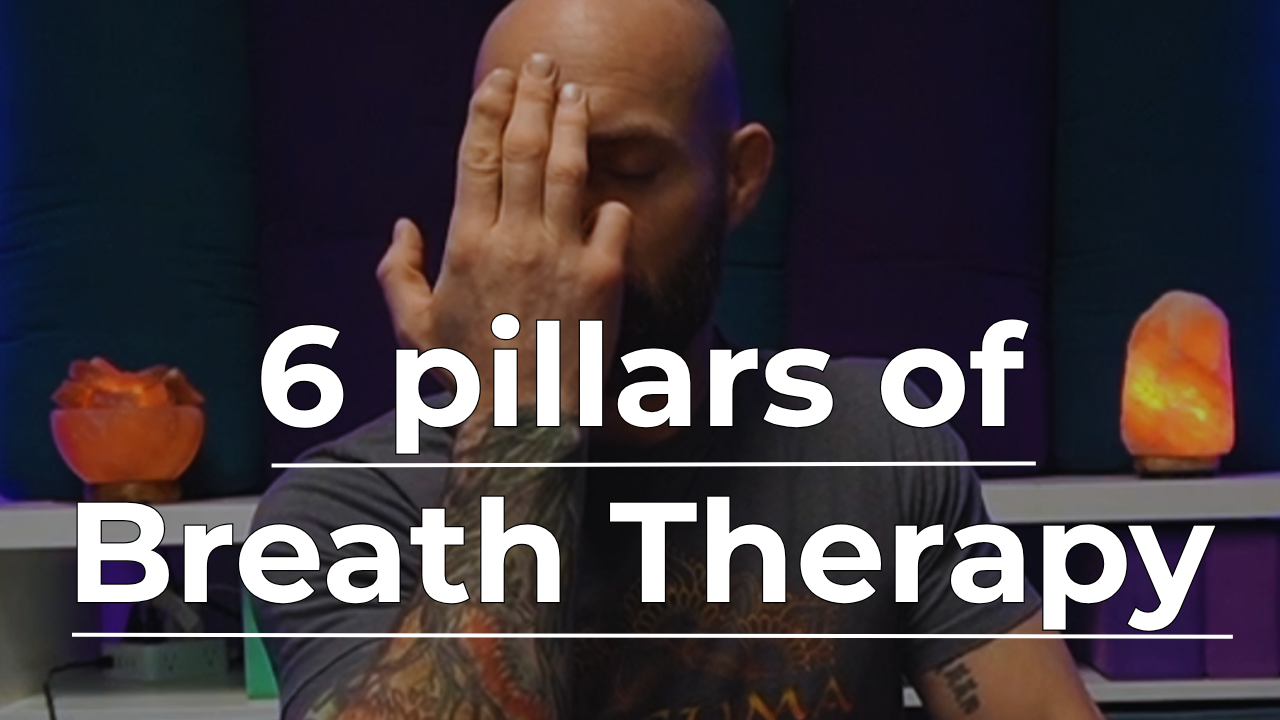
Breath Therapy: 6 Pillars to Wellness Through Breathing
Most people think of breathing as automatic.
Something that just happens in the background.
But over time, through my own practice, I’ve started to see it differently.
Breathing is not just a passive function—it’s something that influences nearly every system in the body.
How you recover.
How much energy you have.
How your body holds tension.
How you move.
How you respond to stress.
To make this more clear and practical, I’ve started organizing breath therapy into six pillars.
Most people think of breathing as automatic.
Something that just happens in the background.
But over time, through my own practice, I’ve started to see it differently.
Breathing is not just a passive function—it’s something that influences nearly every system in the body.
How you recover.
How much energy you have.
How your body holds tension.
How you move.
How you respond to stress.
To make this more clear and practical, I’ve started organizing Breath Therapy into six pillars.
1. Recovery
The Biology of Breathing
Recovery is not just about rest—it’s about how efficiently your body repairs itself.
Breathing plays a key role in:
circulation of oxygen and nutrients
lymphatic flow (your body’s detox system)
activating the parasympathetic nervous system
When breathing is restricted or shallow, recovery is limited.
When breathing is deep and controlled, the body shifts into a state where repair can happen more effectively.
2. Energy
The Chemistry of Breathing
Energy isn’t just about taking in more oxygen.
It’s about how well your body uses it.
Carbon dioxide (CO₂) plays a major role in this process.
It helps release oxygen into your tissues where it’s actually needed.
When breathing is inefficient:
oxygen delivery is reduced
energy levels drop
When breathing is trained:
oxygen is used more effectively
endurance improves
3. Pain
The Neurology of Breathing
Pain is often tied to patterns in the nervous system.
How you sit, move, and breathe creates habits in the body.
Over time, these patterns can lead to:
chronic tension
stiffness
discomfort
Through breath and somatic movement, you can begin to:
interrupt these patterns
retrain muscular systems
restore more natural movement
4. Strength
The Physiology of Breathing
Breathing is deeply connected to your core.
The diaphragm works together with:
abdominal muscles
pelvic floor
spinal stabilizers
When this system is coordinated:
strength improves
movement becomes more efficient
stability increases
Breathing becomes a foundation for functional strength—not separate from it.
5. Stress / Anxiety
Regulation Through Breathing
Your breath directly influences your nervous system.
Fast, shallow breathing is often linked to stress and anxiety.
Slow, controlled breathing signals safety to the body.
Over time, practicing this builds:
resilience to stress
awareness of your internal state
the ability to shift how you feel
6. Digestion & Overall Health
Agni & Internal Function
Breathing influences internal systems in ways many people don’t realize.
From a Western perspective:
diaphragmatic breathing supports digestion
nasal breathing improves sleep
oxygenation supports cellular health
From a yoga perspective, this connects to agni—your internal fire.
You can think of agni as:
👉 your body’s ability to digest, process, and transform energy
When breathing improves, these internal systems tend to function more efficiently.
Closing
What I’ve found in my own practice is that breathing is not simple.
It’s something that has to be learned, practiced, and refined over time.
But when you begin to work with it intentionally,
you start to notice changes across all of these areas.
Not all at once.
Not instantly.
But consistently.
And that’s what this work is really about.
What’s Next
In the coming weeks, I’ll break down each of these pillars more deeply,
and share the specific practices I use and teach.