Breathe Less This Spring
The Nose Is Your First Line of Defense
Your nose is not just for breathing—it’s part of your immune system.
It filters the air.
It regulates airflow.
It protects your lungs from irritants.
When you breathe through your mouth, you bypass that protection.
More air enters.
More pollen enters.
More stress is placed on the system.
Nasal breathing slows things down and reduces the overall load on your body.
Spring, is amazing, maybe my favorite time of year, it brings a lot of good with it.
More light.
More color.
More time outside.
But it also brings something many people struggle with:
Allergies.
Congestion, irritation, and inflammation can make this season feel like something to get through rather than enjoy.
But there’s a simple place to start that often gets overlooked:
Your breath.
The Nose Is Your First Line of Defense
Your nose is not just for breathing—it’s part of your immune system, in fact, it is where the immune system starts.
It filters, conditions, cleanses, and prepares the air.
It releases Nitric Oxide to combat bacteria, viruses, mold, allergens.
It protects your lungs from irritants.
When you breathe through your mouth, you bypass that protection.
More air enters.
More pollen & pollutants enter.
More stress is placed on the system.
Nasal breathing slows things down and reduces the overall load on your body.
Less Breath, Better Function
One of the most helpful shifts you can make is this:
Breathe less.
Not by holding your breath aggressively…
but by reducing the volume of air you move.
When you breathe less:
You bring in fewer irritants
You improve carbon dioxide balance
You support better oxygen delivery
You reduce unnecessary stress on the system
It’s a subtle change—but a powerful one.
A Simple Practice: Short Breath holds.
Try this:
Sit comfortably and begin to gently sway or rock side to side.
Keep your breathing soft and quiet.
Every few breaths:
Exhale naturally
Pause briefly at the end of the exhale
Let the inhale return on its own
Stay relaxed.
Never force the pause.
Practice for a few minutes at a time.
This can help:
Open the sinuses
Reduce congestion
Improve tolerance to carbon dioxide
Bring the nervous system into a more regulated state
Supporting the System
You can also support your breathing and your body with a few simple habits:
Prioritize nasal breathing throughout the day
Wear a mask outdoors if pollen is high
Use a neti pot to clear the nasal passages
Try local raw honey as part of your routine
These aren’t complicated solutions—but they are consistent ones.
The Bigger Picture
Breathing is not just about getting air in and out.
It’s about how your body interacts with its environment.
When your breathing becomes more efficient, more subtle, and more intentional…
your system becomes more resilient.
Final Thought
The goal is not to breathe more.
It’s to breathe better.
And often, that starts with doing less.
Less air.
Less effort.
More awareness.
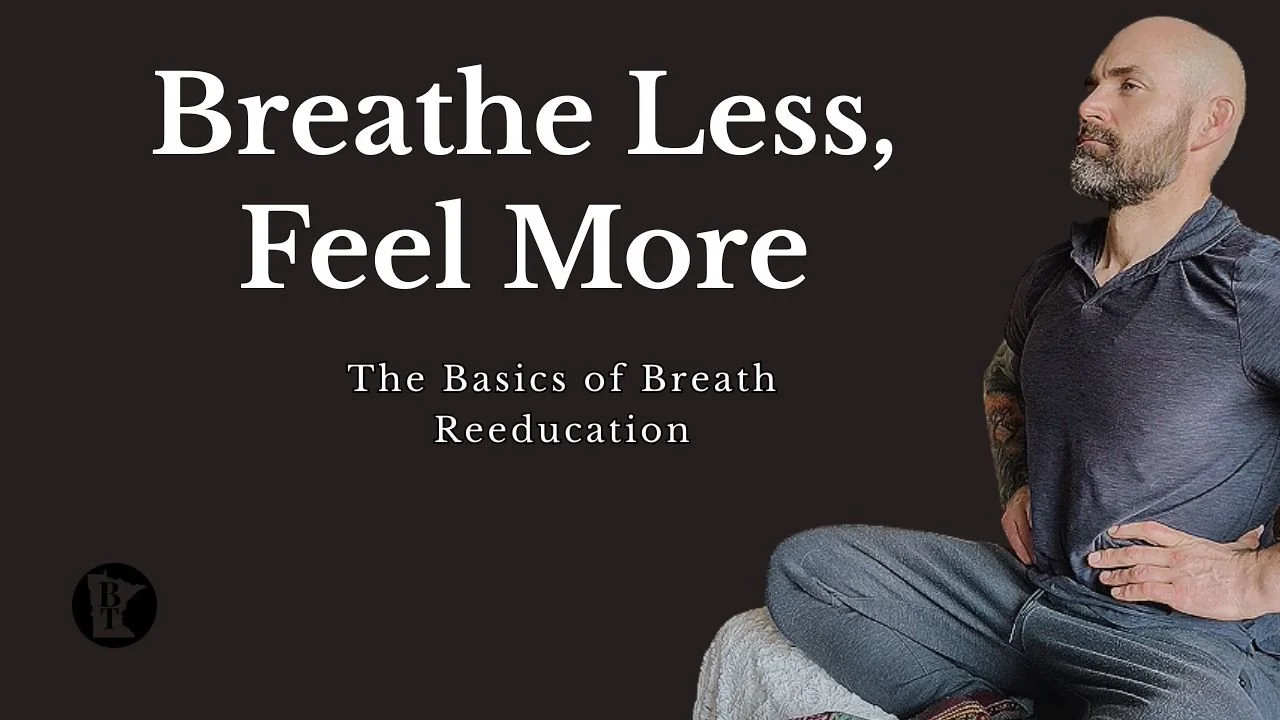
Breathe Less, Feel More
Instead of trying to control your breath…
Let your breath guide your body.
Let the ribs expand.
Let the body respond.
This creates change at a subtle level—what we might call the soma.
And subtle changes, practiced consistently, create meaningful results.
At first glance breathing seems so simple.
You Inhale.
You Exhale.
You Repeat.
But there is far more going and every breath we take can influencing our health either negatively or positively.
Breathing is subtle and very hard to really notice, but the way you breathe has a direct influence on how you feel, how you move, and how your body & mind function. Even a subtle change can create a massive shift.
The challenging part for many people is putting away any idea that we know how to breathe, you must unlearn what you know and approach with a beginners mind. Curiosity, awareness, perception, these are necessary skills that are further cultivated by practicing breathing,
Breath Is More Than Air
Breathing is not just about supplying the body with oxygen.
It’s an entire system that influences:
Your physical body (structure and movement)
Your Energy (life force ~prana)
Your chemistry (oxygen and carbon dioxide balance balance Ph)
Your nervous system (stress and regulation)
Your Mind (focus and clarity)
Every breath reflects your current state.
And over time, the way you breathe can either support your system—or slowly work against it.
The Problem: Too Much Breathing
Most people don’t realize they are over-breathing. This is so hard to witness and change, but it starts with that, witnessing the pattern and knowing that it can be improved… indefinitely.
It is so easy to over breathe, it happens all day as many of our 20-30 thousand breaths re unconscious and part of an unconditioned habit. In fact, over breathing can be as simple as a yawn or any mouth breath.
It doesn’t necessarily mean faster or heavy breathing (which is absolutely overbreathing), it just means that we are taking more in than our metabolic demands, essentially— more volume than needed.
This can lead to:
Increased tension & pain
Reduced efficiency
Nervous system imbalance
Increased inflammation
More air is not always better.
In many cases, it’s the opposite.
The Goal: Less, But Better
Breath reeducation isn’t about forcing technique. I must strain this: You cannot force a change! Consistency, patience, persistence and positivity are the foundation which rests upon the bedrock of curiosity and awareness.
It’s about slowly refining the system.
Two key things begin to change (that are not nose breathing and diaphragmatic breathing):
Your breathing becomes slower: the ideal rate is 6 breaths per minute
Your breathing becomes quieter: ideally no sound or very minimal
Less effort.
Less excess.
More efficiency.
A Simple Way to Begin
One way to explore this is by slowing your breath down.
Try:
Inhale for about 5–6 seconds
Exhale for about 5–6 seconds
Keep it soft.
Keep it quiet.
Let the breath feel smooth, like a wave, gently transitioning between inhale and exhale and exhale into inhale.
Nothing forced, just rolling like a wave, smooth in and out, you’re letting go, and surrendering any bracing.
Bringing Awareness to the Breath
You can also introduce a light ujjayi breath—a gentle narrowing in the throat. It creates a light sound within and is usually practiced during the exhale, but can be done on the inhale as well.
This can:
Slow the breath naturally
Reduce excess air
Improve awareness
Help the diaphragm engage more effectively
Used lightly, it becomes a tool for sensing—not controlling.
Important tip with this practice: make your ujjayi breath subtle and quiet. No one around you should hear you, the sound is internal. It is also called “ocean’s breath” since the sound is like the smooth waves of the ocean on the beach. Imagine that while practicing your breathing and you will feel everything slowing down~ body, breath and mind.
Let the Body Follow
Instead of trying to control your breath, which, again, is very hard to do when your awareness is on your breathing, surrender to the breath…
Let your breath guide your body.
Let the ribs expand.
Let the body respond.
Allow the breath.
This creates change at a subtle level—what we call in yoga the pranamaya kosha.
And subtle changes, practiced consistently, create meaningful + lasting results.
Final Thought
Better breathing isn’t about doing more.
It’s about doing less—more intentionally.
Breathe less.
Feel more.
And always…
Stay consistent, patient, persistent and positive.
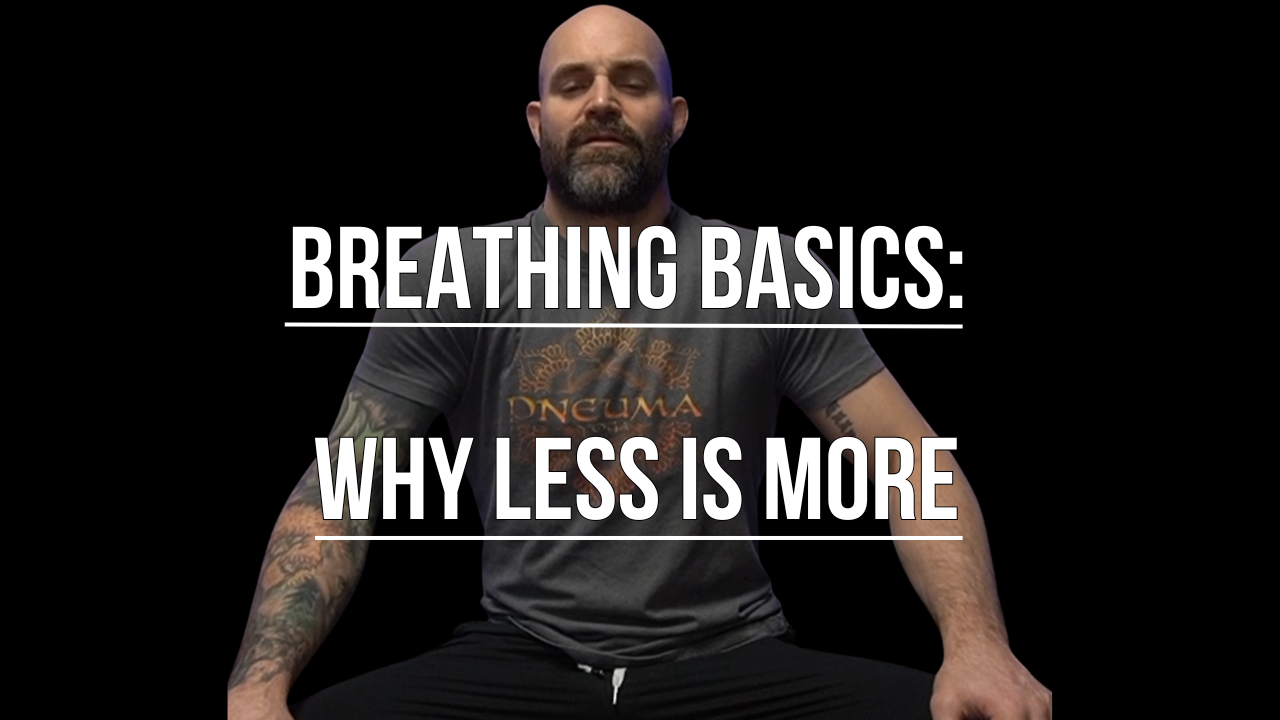
Breathing Basics: Why Less Is More
Breath is not just something you do—it’s something that moves you.
Every movement in your body is influenced by your breathing. Your ribs expand, your spine responds, and your tissues shift with every inhale and exhale.
Breath is the body’s internal rhythm.
When breathing is restricted, movement becomes restricted.
When breathing is smooth, movement becomes fluid.
If you want to move better, it starts with how you breathe.
Breath Is Movement
Breath is not just something you do—it’s something that moves you.
Every movement in your body is influenced by your breathing. Your ribs expand, your spine responds, and your tissues shift with every inhale and exhale.
Breath is the body’s internal rhythm.
When breathing is restricted, movement becomes restricted.
When breathing is smooth, movement becomes fluid.
If you want to move better, it starts with how you breathe.
Breathing Is More Complex Than It Seems
At first glance, breathing looks simple: inhale, exhale, repeat.
But beneath that simplicity is a system influenced by:
Biochemistry — how your body uses oxygen and carbon dioxide
Biomechanics — how your ribs, diaphragm, and posture move
Psychosocial factors — stress, habits, and environment
Every breath reflects your internal state.
And over time, inefficient breathing patterns can reinforce tension, fatigue, and dysregulation in the body.
The Problem: Too Much Breath
One of the most common issues is not a lack of breath…
…but too much of it.
Over-breathing—moving more air than your body needs—can lead to:
Increased tension
Reduced efficiency
Nervous system imbalance
The solution isn’t to breathe bigger.
It’s to breathe more appropriately.
The Goal: Reduce Rate and Volume
Breath reeducation is not about forcing technique.
It’s about refining the system.
Two key variables:
Respiration rate (how fast you breathe)
Respiratory volume (how much air you move)
When both begin to decrease—naturally and without strain—the body becomes more efficient.
A Simple Exploration
Try this:
Count how many breaths you take in one minute
Then slow it down:
Inhale for ~5.5 seconds
Exhale for ~5.5 seconds
Don’t force the breath.
Let it become quieter.
Let it become smoother.
Let the Breath Move the Body
Instead of trying to control your breath…
Allow your breath to guide movement from within.
Let the ribs expand.
Let the body respond.
This creates change at a subtle level of the body—the soma.
And subtle changes, practiced consistently, create powerful results.
Final Thought
Better breathing isn’t about doing more.
It’s about doing less—more intentionally.
Less breath.
Less effort.
More awareness.
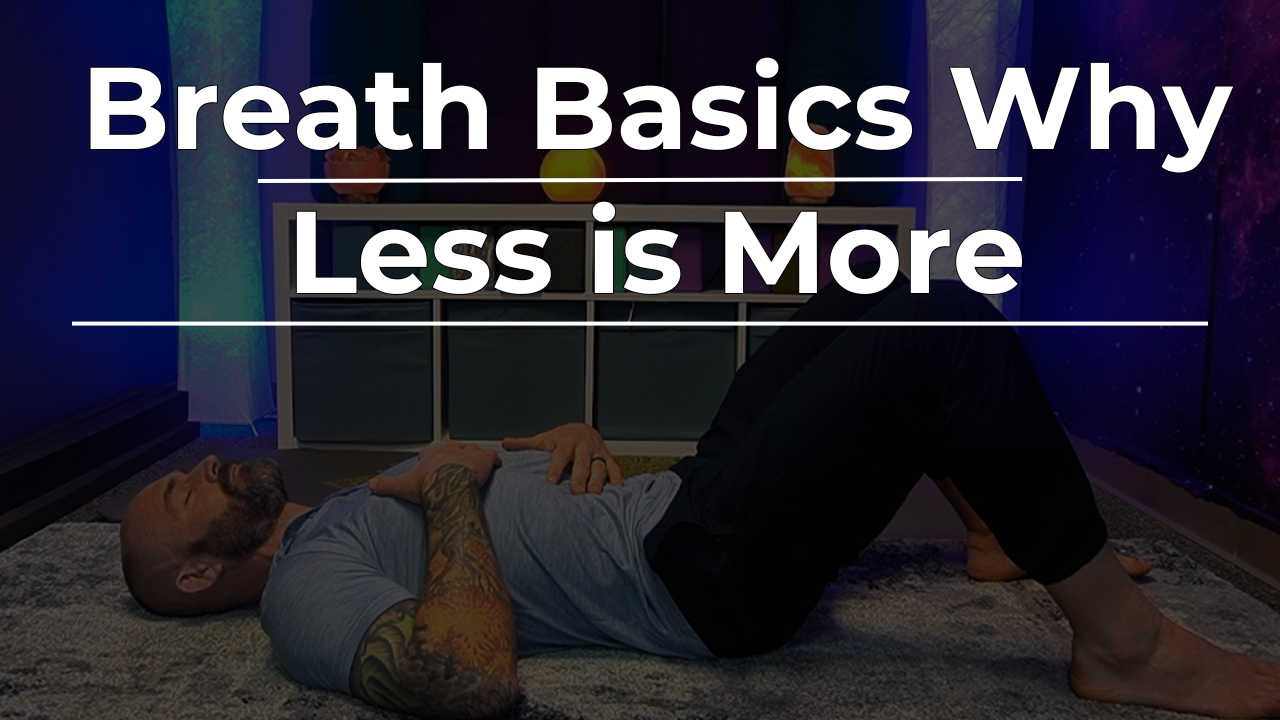
Breath Basics: Why Less is More.
Breathing is something we do all day…
But rarely something we pay attention to.
Most people think better breathing means taking deeper breaths.
In reality, it often means the opposite.
Less breath.
Slower breath.
Quieter breath.
Your breathing is influenced by your body, your stress, and your habits—and over time, it can either support your health or slowly work against it.
Breath Is Movement
Breath is not just something you do—it’s something that moves you.
Every motion in your body is influenced by your breathing. Your ribs expand, your spine responds, your tissues subtly shift with every inhale and exhale. Breath is the body’s internal rhythm.
When breathing is restricted, movement becomes restricted.
When breathing is smooth, movement becomes fluid.
If you want to move better, it starts with how you breathe.
Breathing Is More Complex Than It Seems
At first glance, breathing looks simple: inhale, exhale, repeat.
But underneath that simplicity is a complex system influenced by:
Biochemistry (CO₂ tolerance, oxygen delivery)
Biomechanics (ribs, diaphragm, posture)
Psychosocial factors (stress, habits, environment)
Every breath reflects your internal state.
And over time, poor breathing patterns can reinforce tension, stress, and inefficiency in the body.
The Problem: Too Much Breath
One of the most common issues is over-breathing.
Not necessarily faster—but more volume than the body actually needs.
This can lead to:
Increased tension
Reduced efficiency
Dysregulated nervous system
The solution is not to take deeper breaths.
The solution is to take more appropriate breaths.
The Goal: Reduce Rate and Volume
Breath reeducation isn’t about forcing technique.
It’s about refining the system.
Two key variables:
Respiration rate (how fast you breathe)
Respiratory volume (how much air you move)
When both begin to decrease—naturally and without strain—the system becomes more efficient.
A Simple Exploration
Try this:
Count how many breaths you take in one minute
Then shift your breathing to:
Inhale: 5.5 seconds
Exhale: 5.5 seconds
Don’t force it.
Don’t make it big.
Let the breath become quieter.
Let the body move with it.
Let the Breath Move the Body
Instead of controlling your breath…
Allow your breath to guide movement from within.
This creates change at a subtle level of the body—what we might call the soma.
And subtle changes, over time, create profound results.
Final Thought
Less breath.
Less effort.
More awareness.
That’s where real change begins.
Breath Therapy: 6 Pillars to Wellness Through Breathing
Most people think of breathing as automatic.
Something that just happens in the background.
But over time, through my own practice, I’ve started to see it differently.
Breathing is not just a passive function—it’s something that influences nearly every system in the body.
How you recover.
How much energy you have.
How your body holds tension.
How you move.
How you respond to stress.
To make this more clear and practical, I’ve started organizing breath therapy into six pillars.
Most people think of breathing as automatic.
Something that just happens in the background.
But over time, through my own practice, I’ve started to see it differently.
Breathing is not just a passive function—it’s something that influences nearly every system in the body.
How you recover.
How much energy you have.
How your body holds tension.
How you move.
How you respond to stress.
To make this more clear and practical, I’ve started organizing Breath Therapy into six pillars.
1. Recovery
The Biology of Breathing
Recovery is not just about rest—it’s about how efficiently your body repairs itself.
Breathing plays a key role in:
circulation of oxygen and nutrients
lymphatic flow (your body’s detox system)
activating the parasympathetic nervous system
When breathing is restricted or shallow, recovery is limited.
When breathing is deep and controlled, the body shifts into a state where repair can happen more effectively.
2. Energy
The Chemistry of Breathing
Energy isn’t just about taking in more oxygen.
It’s about how well your body uses it.
Carbon dioxide (CO₂) plays a major role in this process.
It helps release oxygen into your tissues where it’s actually needed.
When breathing is inefficient:
oxygen delivery is reduced
energy levels drop
When breathing is trained:
oxygen is used more effectively
endurance improves
3. Pain
The Neurology of Breathing
Pain is often tied to patterns in the nervous system.
How you sit, move, and breathe creates habits in the body.
Over time, these patterns can lead to:
chronic tension
stiffness
discomfort
Through breath and somatic movement, you can begin to:
interrupt these patterns
retrain muscular systems
restore more natural movement
4. Strength
The Physiology of Breathing
Breathing is deeply connected to your core.
The diaphragm works together with:
abdominal muscles
pelvic floor
spinal stabilizers
When this system is coordinated:
strength improves
movement becomes more efficient
stability increases
Breathing becomes a foundation for functional strength—not separate from it.
5. Stress / Anxiety
Regulation Through Breathing
Your breath directly influences your nervous system.
Fast, shallow breathing is often linked to stress and anxiety.
Slow, controlled breathing signals safety to the body.
Over time, practicing this builds:
resilience to stress
awareness of your internal state
the ability to shift how you feel
6. Digestion & Overall Health
Agni & Internal Function
Breathing influences internal systems in ways many people don’t realize.
From a Western perspective:
diaphragmatic breathing supports digestion
nasal breathing improves sleep
oxygenation supports cellular health
From a yoga perspective, this connects to agni—your internal fire.
You can think of agni as:
👉 your body’s ability to digest, process, and transform energy
When breathing improves, these internal systems tend to function more efficiently.
Closing
What I’ve found in my own practice is that breathing is not simple.
It’s something that has to be learned, practiced, and refined over time.
But when you begin to work with it intentionally,
you start to notice changes across all of these areas.
Not all at once.
Not instantly.
But consistently.
And that’s what this work is really about.
What’s Next
In the coming weeks, I’ll break down each of these pillars more deeply,
and share the specific practices I use and teach.
What the Body Reveals in Stillness
I was standing still this morning. I love doing this, and I practice it often. I get lost in it — standing, breathing, just resting in Mountain Pose.
I’m continually amazed by how much is revealed when I stop moving. How much I’m bracing, without even realizing it.
As I stand, I begin to feel how much tension is contorting me — in my torso, my legs, my shoulders, my neck. It’s not dramatic or obvious at first. It’s subtle. Layered. Quiet. And it makes me wonder: How long have I been ignoring this?
I’ve always known I carry tension. Pain. But for a long time, I resisted simply being here with it. I practice stillness in many ways, but something about standing reveals so much more. When I allow myself to pause, time seems to soften. My breathing lightens. My attention sharpens. I become deeply interested in sensation — every ripple, every pull, every holding pattern.
Standing still becomes anything but still — a complex story of the past woven into unconscious contractions, ebbing and flowing.
The Body Tells Its Story
As awareness deepens, I can feel layers of contraction spiraling through my body, subtly bending and twisting me into awkward shapes. When you pause long enough, you begin to sense that every tissue carries a story — a history written into muscle, fascia, breath, and bone.
This morning, my body began to draw forward and twist — a familiar cringing, protective shape. I noticed a leftward pull, a subtle leaning and rotation. I didn’t resist it. I didn’t try to correct it. I followed it with curiosity.
The pathway felt magnetic — like every fiber knew exactly how to take that shape. It was powerful. Natural.
And suddenly, I wasn’t just in my body.
I wasn’t in an accident or out of surgery.
I was back in the kitchen.
How Work Shapes the Body
I could feel it clearly — I was working at our family restaurant, Mr. Pizza in Rochester, Minnesota. I could sense everything: the sounds, the smells, the intensity, the pace. My body subtly adjusted as if reaching across the counter, pivoting, turning.
My mind whirled through memories of throwing pizzas into the oven, pivoting back and forth. Pivoting again. Cutting. Boxing. Moving.
Over and over.
The same pattern.
The same posture.
Year after year.
I had shaped my body to be efficient.
Leaning forward.
Twisting.
Reaching.
Reacting.
My nervous system learned every detail of that environment — how to move quickly, how to respond instantly, how to stay in overdrive. Add in past injuries, illness, stress, and exhaustion, and over time pain became normal. Burnout became normal. Drinking became normal — a way to cope with pain I didn’t yet understand.
I stretched. I exercised. I rested. I sought help.
But the pain always came back.
Because I was never addressing the pattern beneath it all.
Learning to Feel What Was Hidden
It wasn’t until I discovered somatic yoga and breathwork that I began to understand what was actually happening inside me. And even then, I had no idea how thick the layer of resistance was — the resistance that prevented my mind from seeing the tension that was holding me so tightly.
It’s so difficult to sense our own body. Profoundly difficult.
Somatic practice taught me something humbling:
I didn’t know myself nearly as well as I thought I did.
Six years later, I can honestly say something surprising — I feel like I know even less now. Not because I’ve gone backward, but because awareness has expanded. The deeper you look, the more complexity you discover.
Life is like that.
A leaf looks simple… until you study it.
An ant seems small… until you observe it closely.
Everything unravels into infinite detail.
Turning inward is no different.
The body is like that.
The breath is like that.
The mind is like that.
The more subtle the awareness, the more layers reveal themselves.
A Universe Within
That’s why Mountain Pose continues to feel so fresh and alive for me. The stiller I am — the longer I stay — the more truth reveals itself: there is an entire universe within.
And the more I unravel it, the better I feel — not because I’ve “fixed” anything, but because I’m getting out of the way… because I am finally listening.
There is always more to discover.
Always more to refine.
Always more to feel.
And instead of that being discouraging, I find it deeply exciting.
A Mirror for You
If you’ve ever felt stuck in one posture, one pattern, one way of holding yourself — physically or emotionally — your body may be telling a story too.
You don’t have to fix it.
You don’t have to stretch it away.
You don’t have to force change.
Sometimes, the most powerful thing you can do is pause… stand still… and listen.
We are not meant to break down as we age.
We are meant to refine, enhance, and deepen ourselves.
That is the heart of this work.
That is the dedication behind Pneuma Yoga.
Simple practices.
Honest awareness.
Turning inward.
Reshaping health and vitality — not by force, but by presence.
Sometimes, all it takes…
is standing still.
Ahimsa: My First Step into Yoga Philosophy
There is no yoga without nonviolence.
I stumbled into yoga almost by accident… or more accurately, by injury.
I tore my pectoral in a jiu-jitsu sparring match, and since I couldn’t lift weights anymore, I looked elsewhere. My earliest yoga “practice” came through infomercials and biceps—P90X with Tony Horton. That was my gateway into western yoga, and honestly, I loved it.
From there I dove deeper into YouTube flows, DVDs from the library, and random classes—still mostly focused on the physical: stretching, sweating, pushing myself. I had no idea yoga held anything deeper. I was barely scratching the surface.
Stumbling Toward Something More
Eventually I reached a point where I knew I needed something different. My health was falling apart. My nervous system was burned out. The restaurant job was crushing me. I felt stuck in a loop of illness, stress, and the terrifying sense that there was nowhere to go for real resolution.
Inside me, something was aching to come out. I knew it had to do with holistic health. I suspected yoga was involved somehow, but I didn’t yet understand the depth of yoga or how much wisdom it carries about the human mechanism. I remember wondering, Do I really want to teach yoga classes? What could possibly be so special about yoga?
Back then, I had no idea.
Stuck in Survival Mode
My life at that time felt like one long, stressed-out shutdown response.
I was working long hours in a chaotic restaurant environment. My body was in too much discomfort to keep going, yet I didn’t see a way out. Simply surviving each day was a battle. Running a business on top of that was another battle I had no capacity to fight.
I felt skill-less, empty, like I had nothing of value to offer the world. My health was declining and my sense of self collapsed with it. Shame, exhaustion, self-judgment—they were my constant companions.
I believed deeply that the body could heal itself, and I believed nutrition was the key. I followed what I thought was a “healthy” eating lifestyle to fix my gut pain. But nutrition is confusing, and everyone claims their way is the right way. I ate whole foods and followed paleo because people I trusted told me it was the answer.
Still, my body kept failing.
Later, Ayurveda would completely transform my understanding of food, digestion, and what “healthy” actually means—but that wisdom came much later. At the time, all I knew was this:
I was not okay. And I couldn’t fix it with willpower alone.
My First Real Step Into Yoga
When I eventually enrolled in a yoga therapy program—right at the start of COVID, entirely over Zoom—I was completely ungroomed as a yogi. I knew nothing except poses. Yet there I was: signed up for a 1,000-hour training, committed to seeing it through.
That program cracked something open in me.
I began to actually study yoga—not just the shapes, but the philosophy. The depth of yoga was overwhelming at first. The sages who shaped this science were some of the most intelligent minds to ever live. Their teachings were dense, intricate, and profound. Hard to grasp at first… but captivating.
Slowly, the philosophy began to seep into me.
And what hit me the hardest was Ahimsa.
Ahimsa: The Foundation of Yoga
The first concept I truly met was Ahimsa—nonviolence.
It is the very first yama, the first branch of the first limb.
It is literally the beginning of yoga.
At first it seemed simple: Don’t be violent.
I wasn’t hitting anyone. I didn’t think of myself as harmful. I had no awareness of the subtle ways I punished myself, the frustration simmering inside me, the harshness I directed inward. So I thought:
“Okay, cool—what’s next?”
But as I sat with Ahimsa, something shifted.
I began to hear the violence that lived inside me.
Seeing My Own Violence
As I reflected on Ahimsa, I saw how deeply I was harming myself:
the way I talked to myself
the shame and self-blame
the comparisons and judgments
the constant inner criticism
the pushing past my limits
the overworking, the drinking, the refusal to rest
I realized that the deepest violence in my life wasn’t external.
It was internal.
Yoga teaches pratipaksha bhavana—cultivating the opposite.
When negative or harmful thoughts arise, we consciously shift toward their opposite: thoughts that are true, kind, supportive, aligned.
The mind is incredibly powerful.
It shapes our experience of reality.
It colors everything we perceive.
It can create us or destroy us.
If we repeat violent stories inside our mind, the body will live inside that violence.
Learning Ahimsa meant finally seeing this clearly—
and then slowly choosing a different direction.
Creating a Nonviolent Inner Environment
If healing is the goal, we must build an inner world that supports healing.
The body is unbelievably intelligent and wants to move toward balance.
But it cannot heal if the mind is constantly attacking it.
Ahimsa is not just “be kind.”
It is a radical commitment to:
dropping shame and self-punishment
interrupting cycles of judgment and comparison
noticing where we are sharp, cruel, or impatient
choosing thoughts and actions that support life, not harm it
Yogi Swami Rama said:
“Love all and exclude none.”
That includes ourselves.
If we want true health, we must become love within—not as sentimentality but as alignment with our true nature.
Violence is everywhere in the world. But it doesn’t have to live in us.
Ahimsa in Practice: Food, Animals, and Daily Life
For me, Ahimsa showed up in a clear and unexpected way: food.
I’ve been vegetarian or plant-based for years, but through Ahimsa, that choice deepened. It helped me see the subtle violence not only toward animals, but toward my own body and the earth.
Ahimsa became a practice of:
nonviolence toward my body
nonviolence toward other beings
nonviolence toward the planet
And no, this doesn’t mean perfection.
Negativity still arises. Old patterns still surface. The mind still reacts.
But the practice becomes:
Notice. Breathe. Choose differently.
We can learn to stay grounded enough inside that we are not so easily pulled into reactive violence—whether in thought, word, or action.
No Yoga Without Ahimsa
Yoga is not about flexibility or strength.
It is about creating a mind and heart that can hold life without causing harm.
Ahimsa is the very beginning.
It is the root.
The ground of yoga.
Without nonviolence, there is no yoga—only performance, ego, or spiritual decoration.
Ahimsa reminds me:
to speak more gently to myself
to give my body time and space to heal
to step out of self-destruction
to move through the world with a little more care
If you want to explore your truest health, start here.
Notice where violence lives in your thoughts, your habits, your choices—then cultivate the opposite, little by little.
Healing is not just physical.
It is mental, emotional, and energetic.
Create a nonviolent inner environment, and the body will know what to do.